Want to see some great examples of student blogging? Visit the Possibilities Abound blog by Lani for her 3/6 post: There's something happening here!
Not only are there great examples of high school students blogging about their learning in pre-calculus class (great reflective posts), but there's a mini-story in the post about a 5th grader elsewhere posting a comment and the subsequent connection between the high school students and their new friend, Eddie. Very inspiring!
And in many of the posts (please follow the links -- there are many great gems to uncover), the students write about how much their teacher's use of an interactive white board has changed their class and how they are now using the white board as well as the teacher.
A tip of the hat to Jim Gates' TipLine blog and Anne Davis' EduBlog Insights for pointing me to Lani's post. Jim's post actually references Lani's post via Anne's Tell the Stories post.
And that's why it's call The Web. BTW, you'll see Jim's and Anne's posts in my Shared items listed to the right. Lots of other goodies there that I haven't blogged about -- yet...
Showing posts with label education. Show all posts
Showing posts with label education. Show all posts
Wednesday, March 7, 2007


Wednesday, February 28, 2007
From Mirrors to Amplifiers: More on School 2.0
David Warlick has an insightful post on his 2 Cents Worth blog -- More on School 2.0 -- with the following comparisons between School 1.o...
...and School 2.0...
And in David's inimitable way, he has characterized this shift with this pithy statement:
David also has two great diagrams of School 1.o and School 2.o to illustrate.
Here is the School 2.o diagram:
This is a great way of capturing the transformative shift we are all aiming for. As I read the post, I couldn't help envisioning the mirrors (students) in School 1.0 morphing into prisms in School 2.0 both amplifying and refracting ideas and information in all directions -- like a superconducting super collider for education!
The one exception I'll take to David's post is in his opening paragraph statement:
I can understand David's perspective. He's been banging the drum for quite a while now, and he's probably seeing a change in his audiences from "wow, gee whiz" responses to a lot of nodding of heads -- many bent over their laptops busily blogging their reflections or capturing notes on a wiki for colleagues or a future podcast. But, David's audience is often made up of the vanguard -- those ready and willing to embrace the technology and the educational reform. We, in turn, go back to our schools and work with many teachers that are just getting past the notion that the technology is inevitable and are struggling with the day-to-day pressures of conflicting local initiatives without little time to breathe, let alone reflect. I'd have to say the vast majority still are not clear on the differences between a blog, wiki, or podcast or, more importantly, why it makes a difference for education. I think there's lots more work for us to do in that arena.
Just this past Monday, we had Will Richardson do a day-long workshop in our district for about 40 teachers and administrators. Will did an amazing job (as always) of delivering a compelling case for the impact of Web 2.0 tools on education. But I spent over an hour afterward continuing the conversation with several attendees helping them digest and sort out Will's presentation. For many, this was the first time they had spent any substantial time considering these tools and their potential. To be sure, there were a few in attendance who already have blogs and have done some podcasting and worked on wikis -- even a number who have used these in class with their students. But the majority were still in the "wow, gee whiz" phase. So there is much yet to done at the school and classroom level.
But, David, please move ahead. The implications of School 2.0 as an extension of the Web 2.0 metaphor is an important one as we all figure out how education must adapt to the ever changing tools of collaboration and connective technology.
Teachers deliver content and skills, students are mirrors, reflecting content and skills back to the teacher (or government). If the reflection is in the image of the teacher and the state’s standards, then success has been achieved — regardless of any continuing affects on the students abilities to prosper in a rapidly changing time.
...and School 2.0...
Teacher’s become learners and learners become teachers, and each side is empower with conversation, control over their information landscape, and connections with each other — with almost no constraints of hierarchy.
And in David's inimitable way, he has characterized this shift with this pithy statement:
Students stop being mirrors, and instead become amplifiers. Their job is not merely to reflect what they encounter, but to add value to it.
David also has two great diagrams of School 1.o and School 2.o to illustrate.
Here is the School 2.o diagram:
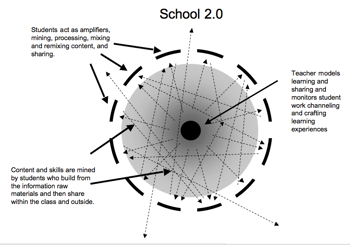
This is a great way of capturing the transformative shift we are all aiming for. As I read the post, I couldn't help envisioning the mirrors (students) in School 1.0 morphing into prisms in School 2.0 both amplifying and refracting ideas and information in all directions -- like a superconducting super collider for education!
The one exception I'll take to David's post is in his opening paragraph statement:
But most everyone now knows what a blog is, wikis hold no mystery, we’ve gotten over wikipedia, and podcasting is no longer the “next big thing.”
I can understand David's perspective. He's been banging the drum for quite a while now, and he's probably seeing a change in his audiences from "wow, gee whiz" responses to a lot of nodding of heads -- many bent over their laptops busily blogging their reflections or capturing notes on a wiki for colleagues or a future podcast. But, David's audience is often made up of the vanguard -- those ready and willing to embrace the technology and the educational reform. We, in turn, go back to our schools and work with many teachers that are just getting past the notion that the technology is inevitable and are struggling with the day-to-day pressures of conflicting local initiatives without little time to breathe, let alone reflect. I'd have to say the vast majority still are not clear on the differences between a blog, wiki, or podcast or, more importantly, why it makes a difference for education. I think there's lots more work for us to do in that arena.
Just this past Monday, we had Will Richardson do a day-long workshop in our district for about 40 teachers and administrators. Will did an amazing job (as always) of delivering a compelling case for the impact of Web 2.0 tools on education. But I spent over an hour afterward continuing the conversation with several attendees helping them digest and sort out Will's presentation. For many, this was the first time they had spent any substantial time considering these tools and their potential. To be sure, there were a few in attendance who already have blogs and have done some podcasting and worked on wikis -- even a number who have used these in class with their students. But the majority were still in the "wow, gee whiz" phase. So there is much yet to done at the school and classroom level.
But, David, please move ahead. The implications of School 2.0 as an extension of the Web 2.0 metaphor is an important one as we all figure out how education must adapt to the ever changing tools of collaboration and connective technology.
Saturday, February 24, 2007
The Accuracy of Wikipedia
Will Richardson posts in weblogg-ed:
This makes sense to me even though it contradicts the fears of many educators. And it is interesting in relation to something I've recently learned about the Wikipedia founders starting a new venture:
As posted in Accelating Minds:
I just wonder if this is really needed. I'm not sure it will be able to get the same kind of traction that Wikipedia already has.
Research on Wikipedia/Trusting the Source of the Source
(Via Smart Mobs) So here is a research study (and I mean research, full of all sorts of funny looking formulas and symbols and stuff) about Wikipedia that comes to the conclusion that the more edits there are to a particular article the more accurate it is.
This makes sense to me even though it contradicts the fears of many educators. And it is interesting in relation to something I've recently learned about the Wikipedia founders starting a new venture:
As posted in Accelating Minds:
The folks at Wikipedia are launching a new site, Citizendium. It strives to become a more authoritative version of its predecessor, and a boon for us in education. It looks to me like, after registering and signing in, students can still research and then contribute to the pages.Wikipedia 2.0
I just wonder if this is really needed. I'm not sure it will be able to get the same kind of traction that Wikipedia already has.
Tuesday, February 20, 2007
Tech to D.I. For: Technology and Differentiated Instruction
I just posted a podcast to the LMSD Podologue of my presentation last week at the Pennsylvania Educational Technology Exposition and Conference (PETE&C) in Hershey, PA. My topic was technology and differentiated instruction -- web resources for D.I., technology-enhanced strategies for D.I., and powerful ways technology and D.I. might be combined.
As a part of the presentation, I introduced a public wiki -- Tech 4 D.I. -- that I set up to promote the use of technology to differentiate instruction. The wiki includes all the links from my presentations (and then some), and all are invited to add links and add to the annotations for the links. In addition, I set up pages to share ideas, tips, and strategies for using technology to differentiate content, process, product, and the classroom environment. Please visit the wiki and contribute or join in a discussion on any of the pages.
As a part of the presentation, I introduced a public wiki -- Tech 4 D.I. -- that I set up to promote the use of technology to differentiate instruction. The wiki includes all the links from my presentations (and then some), and all are invited to add links and add to the annotations for the links. In addition, I set up pages to share ideas, tips, and strategies for using technology to differentiate content, process, product, and the classroom environment. Please visit the wiki and contribute or join in a discussion on any of the pages.
Friday, February 9, 2007
Understanding by Design Podcasts
I have posted four podcast episodes to the LMSD Podologue from presentations given at the third in-service day for Lower Merion School District new teacher assistance program (NTAP). These are very basic introductions to the Understanding by Design framework with a focus on Stages 1 and 2 only. The first episode is an introductory overview of UbD and how it relates to Differentiated Instruction. This second deals with big ideas, standards and benchmarks, knowledge and skills and how that all can be expressed as enduring understandings in the UbD framework. The third episode introduces Essential Questions to focus teacher design and inspire and direct student learning. The fourth episode deals with the importance of developing summative performance-based assessments aligned to the standards and benchmarks, enduring understandings, and essential questions in Stage 2 of the UbD framework.
Sunday, January 28, 2007
From Podcasting to Pilot to Student iPods - Podcast
I finally finished preparing and uploading to the LMSD Podologue a three-episode series of a presentation given in Apple Seminars on October 25, 2006, at the Chester County Intermediate Unit and, again, on December 7, 2006, at the Bucks County Intermediate Unit. The presentation was titled: iPod, uPod, wePod, theyPod: from podcasting to pilot to student iPods and the presenters included Virginia DiMedio, Director of Information Technology for Lower Merion School District (Ardmore, PA), and Mary Kirchner, World Languages Chair at Lower Merion High School, along with me.
The presentation was in three parts which made it easy to split the podcast into three episodes. The first part of the presentation describes the initial use of podcasting in LMSD as a tool for professional development (me), the second part tells how LMSD got started with student podcasting through a pilot project in the 2005-06 school year (Ginny and me), and the second part tells how LMSD got started with student podcasting through a pilot project in the 2005-06 school year (Mary).
The presentation was in three parts which made it easy to split the podcast into three episodes. The first part of the presentation describes the initial use of podcasting in LMSD as a tool for professional development (me), the second part tells how LMSD got started with student podcasting through a pilot project in the 2005-06 school year (Ginny and me), and the second part tells how LMSD got started with student podcasting through a pilot project in the 2005-06 school year (Mary).
Subscribe to:
Posts (Atom)